
In a world where customers expect attention that is personal, precise and immediate, Hyper-Personalization is turning from an innovative approach into the new standard. It means deep personalization, built on data and artificial intelligence, designed to offer individually tailored experiences at the highest level – at every customer touchpoint.

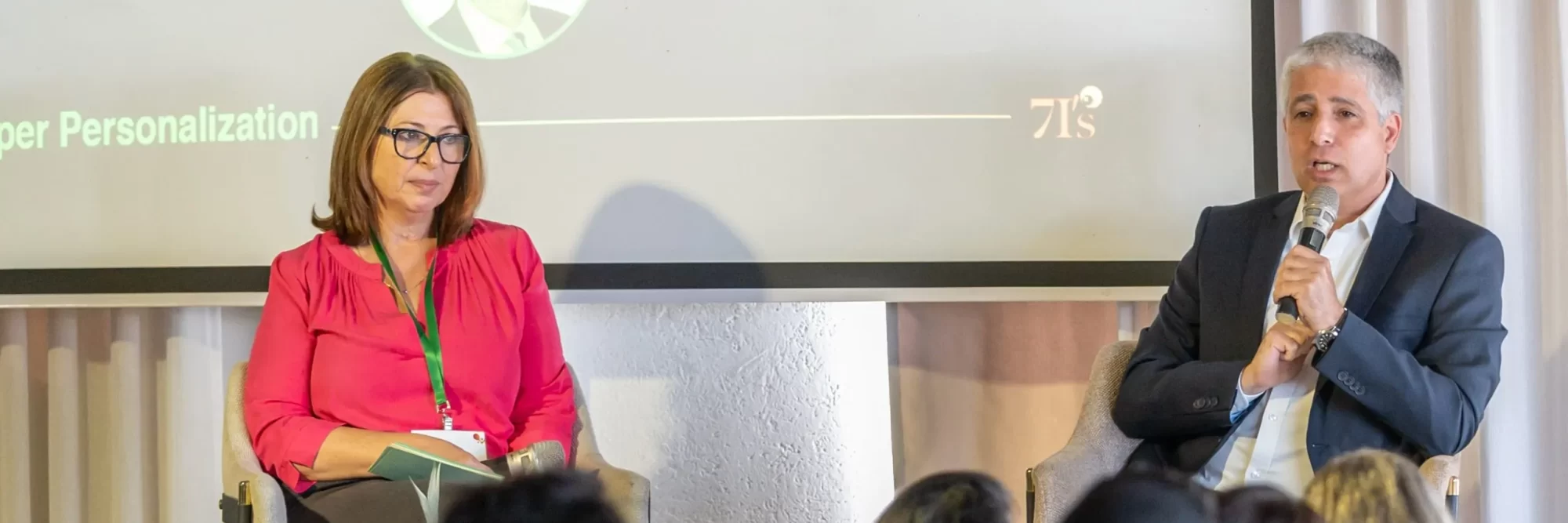
At the executive roundtable led by 7I’s together with Tiff and CommBox, held in October 2025,
we examined personalization in service from several different angles
The journey from in-person branch service to personalized digital service
Customer service used to rest on a personal relationship with a representative at the branch – a banker, a doctor, an insurance agent or a salesperson. Personal familiarity, a face-to-face conversation, and reading needs out of human interaction were the basis of the service experience. As Asaf Eldar, Head of the Retail Division at Discount Bank, described it,
“Walking into the bank and seeing a familiar face gave me a different feeling… It will be hard to reproduce the depth of emotion people felt – it probably creates far more chemistry than I can imagine.”
Over the years, and mainly on the back of accelerating digitization – including COVID and the war – service moved to centralized contact centers, mobile apps, and websites . The central challenge: how do you preserve that personal, empathetic feeling when the service is delivered remotely and automatically?
Today, leading organizations are building Hyper-Personalization capabilities – deep personalization based on data, AI, and precise identification of the customer’s needs in real time. The goal: to bring the personal feeling back, this time with technology.
Why does this matter now?
Customers are already there. They are used to tailored service from platforms such as NETFLIX – 80% of viewing on Netflix is the result of personalization – and the same holds for digital platforms like Amazon and Google.
Customers expect the organization to recognize them, understand their needs, and offer them the right thing, at the right time, in the right channel. As Asaf Eldar put it, “Ultimately, people simply want the right response to what they need in that moment.”
A 2025 Medallia survey covering the preferences of 23,000 customers found that 61% of consumers are willing to pay more for a personalized experience, while only about 25% of consumers have experienced a very high level of personalization
“Personalization is a question of resolution”
Eldar highlighted the gap between what organizations imagine and what customers actually need, and warned against shallow personalization built on nothing more than basic customer details.
Udi Asulin, Head of the Telephone Service Operation at Maccabi Healthcare Services (a large Israeli HMO), described the establishment of specialized contact centers designed to provide tailored service to different populations. While this might have seemed likely to reduce operational efficiency, in practice it led to a 10% decrease in repeat calls. In his words,,
“If we don’t know how to connect with the customer’s needs and make the service more accessible based on the information we already have, then it isn’t truly personalized – and we’ll never move toward hyper-personalization.”
We also learned that when service is personalized, accuracy matters. According to Qualtrics (2025), 61% of consumers identify “reliable information” as the most important element of the customer experience. (Qualtrics 2025)
Shai Ben Moshe, Head of the Customers, Sales and Service Division at Bank Hapoalim, emphasized the importance of precision in personalization:
“If we offer a customer something that isn’t right for them, it frustrates them and ultimately has the opposite effect.”
53% of consumers say they will cut their spending on a brand after an unsatisfactory experience (Qualtrics 2025)
We learned that it is worth examining and sharpening the line between personal service and the customer’s privacy.
Udi Asulin at Maccabi noted that customers often expect organizations to use the information they already have about them. However, medical confidentiality naturally limits how that information can be used, creating a gap between customer expectations and data protection requirements. Nir Lautman, Chief Customer Officer at Clal Finance and Insurance shared that they chose a different approach: surprising customers in moments completely unrelated to insurance – “happy moments,” such as sending a gift to a new mother.
Lautman also explained that in the insurance industry, knowing the customer has always been fundamental to calculating premiums. Today, data makes it possible to understand customers at a much more granular level, identify their individual needs, and develop products tailored to them. One example is Clal BEHAVE in motor insurance, which uses driving data to allow customers who drive safely to pay lower premiums.
Aliza Gavra, CDO and CX at MAX, described a location-based personalized service that was perceived by customers as “Big Brother.” After reviewing customer feedback, the company decided to discontinue the service.
Elad Mizrahi, CEO at Tiff described the implementation of bots in collaboration with CommBox and emphasized the importance of maintaining continuity throughout any process that begins with a bot. Continuously examining customer intent and identifying actions that were not completed by the bot, while ensuring that all relevant information is carried forward throughout the customer journey, is essential to building customer trust in automated personalization.
We are all only at the beginning this is the time to dream
Even leading organizations are still in the early stages of implementing hyper-personalization. It is a long journey that requires patience, experimentation, and learning through trial and error. As Asaf Eldar noted,
“The war acted as a catalyst for many technological processes – it removed barriers and accelerated projects that had originally been planned to take six months but were completed in just two weeks.”
According to the 7I’s 2025 survey of 40 companies that participated in the roundtable, 50% of organizations in Israel already include personalization in their strategy. However, only half of those organizations have allocated a dedicated budget, and even fewer have aligned their organizational targets accordingly.
Karni Kaplan, an expert in Contact Center operations and technology, noted that while AI was expected to drive efficiency in human-assisted customer service, the adoption rate of AI tools in customer service currently stands at just 24%.


Technology is necessary, but not sufficient

Advanced technology infrastructure and AI capabilities are essential, but the momentum must come from within the organization itself.
This transformation requires changes to the organizational structure, service and sales processes, metrics, and culture. For example, Udi Asulin described how Maccabi Healthcare Services conducted a detailed mapping of customer journeys in collaboration with its medical division, leading to a significant improvement in the availability of physiotherapy services.
Aliza Gavra emphasized the importance of organizational structure:
“There is a dedicated role within the organization – the Customer Experience Manager – whose job is to listen, understand, and deliver the right solution.”
Quality data is the foundation of everything
Without a strong, clean, and up-to-date data foundation, effective personalization is simply not possible. Aliza Gavra (MAX) described data as the fuel that powers the engine, emphasizing that quality data is the foundation of everything. Without it, she argued, there can be no true personalization.
Gavra (MAX) also highlighted the need to tailor the customer experience to the different identities of the same customer, as well as the importance of accurately measuring digital channel adoption.
According to the 7I’s June 2025 survey, 88% of organizations report that they are not yet realizing the full potential of their data for personalization.
We asked participants what they had learned from experience?
- Dream big, start small – Don’t wait for the perfect solution. Start with small, measurable steps that deliver immediate value. As Asaf Eldar put it: “It’s better to give the customer something of value than to wait until you can build the entire vision.”
- Identify high-value customer segments and moments – Focus on the areas where hyper-personalization can create meaningful value for both the customer and the organization. Clal Insurance, for example, developed a product that monitors customers’ driving behavior and offers premiums tailored to how they drive.
- Drive change across the organization – Cultural change is essential to success. Personalization is not just about technology; it requires a different way of thinking. As Asaf Eldar noted: “As Israelis, we need to understand our customers – including the fact that they are often looking for a sense of special treatment and turn that into personalization.”
After an insightful day, we concluded…
Hyper-personalization is more than just a buzzword – it represents a fundamental shift in the way organizations think about and engage with their customers. Organizations that successfully balance technology, data, and human sensitivity will be better positioned to lead the market. The executives who participated in the roundtable emphasized that this is a journey that requires vision, flexibility, and a genuine ability to listen to the customer.


